
Sony TR-6
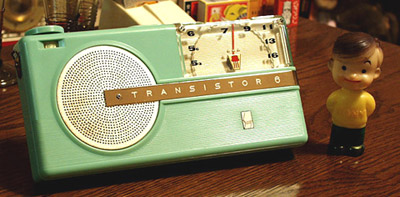
"Totsuko" (Tokyo Tsushin Kogyo Ltd. - later to become Sony Corp.) announced the Sony TR-6 in May 1956 and documentation suggests it actually went on sale in late June. The product-cycle ran close to one year. This was the first transistor radio to earn a reputation in Japanese audio and radio magazines for delivering good enough quality to compete with tube sets, while also realizing a new dimension in portability and design. In fact, I'm told the fame the model earned domestically was such that many Japanese thought the TR-6 was Totsuko's first radio.
A retrospective article from Sony on the company's early radios praises the cabinet design of the TR-6 as a complete departure from anything previously made and refers to its slim form factor as a ‘bento-bako’ (Japanese lunch box) design. Obviously, the Japanese idea of a lunch box differs from that in the West! On the technical side, the circuit board is the last in a Sony Radio to use the common bias architecture that was implemented in the TR-55 the previous summer. (For those not familiar, the TR-55 was released in August 1955 as the company's first transistor radio).
Sadly, precious few samples remain, and the majority of the ones I've seen have suffered considerable damage. Given that this was such a famous model in Japan, you might wonder why we don't see more of them today.
For starters, total production numbers were small.* Totsuko was a relatively small company in 1956, and was the only Japanese maker at the time capable of building transistors or transistor radios in production quantities. The market the company had pioneered was not even a year old. Consumers were not aware of nor concerned about the advantages of the transistor. Roughly 75% already owned a tube radio. And the initial purchase price of a tube radio was far less expensive. The TR-6 was therefore viewed as prohibitively expensive to the majority of Japanese consumers. We're talking the equivalent of close to two month's salary for the average white-collar worker wanting to buy the privilege to flash one of these around in front of the co-workers. Despite the lofty purchase price and other challenges within the domestic market, most units were sold in Japan. Totsuko had not yet entered the U.S. market in '56, and the transistor radio market proper was still in its infancy and relatively small. A modest quantity of TR-6 radios were imported to Canada by Gendis (General Distributors Ltd.), Sony's first overseas distributor, as well as to Australia and Europe.
Another factor making the TR-6 a rare bird is that the cabinet did not survive the years well. It was compression moulded using urea formaldehyde, a rigid hard thermoset plastic that tends to grow more brittle over the years. While its walls are nice and thick, the cabinet liked to self-destruct if dropped or tapped strongly against any hard surface. I've traced the history of a number of units and to date all but a small handful are chipped and cracked. Another drawback of the plastic used for the cabinet is that once it is cracked, the fissure, if not stopped, likes to continue creeping right through the body until it comes out at the other end. And it's not an easy material to repair well.
As a digression, many veteran collectors I have the pleasure to communicate with have never had the opportunity to see a TR-6 up close. This may be one reason that oh so many Stateside friends and collectors tend to think that the TR-6 is the same radio as the Hoffman Home & Travel P411 Solar and P410 battery-powered models. Not so. While the cabinets and volume switches on the Hoffman were indeed supplied by Sony, the moulds differ slightly and the colour selection is also different. More importantly, the chassis (the "radio") is completely different. But I'll discuss this on a separate page to come in the near future.
* I am certain the total production numbers were far smaller than the figure shown on the couple of unauthorized lists that have made the rounds amongst collectors. These lists all show the same figures because they all appear to stem from the same document of uncertain origin that was plagiarized, sold to collectors several years ago, and "borrowed" yet again. While many of the production quantities on the list are close enough to have fun with, especially the later ones, the number given for the TR-6 is unreliable. Based on what is known of Totsuko's production of transistors (the parts) from May 1956 through spring of 1957 and the other period documents available today, it's highly unlikely the company could have produced more than 10,000 units. The challenge to find the true figure has begun; and the hunt should be fun.